
|
|

| Albero: Recercata y Sonata sesta |
|
Sebastián Albero (1722 Roncal, Navarra - 1756 Madrid) is one of the most important composers of Spanish keyboard music of the 18th century. His musical training began in the Musical Chapel at Pamplona´s Cathedral and his career culminated at the Royal Chapel in Madrid in the service of King Fernando VI. |
|
He lived at the Palace along with Scarlatti. While the Scarlatti was serving Queen María Bárbara, Albero was the King’s organist in the Royal Chapel. |
|
He left few works but of great quality having died very young. His "Recercatas" are magnificent examples of free and superlative creations of the composer. Although structurally Scarlatti’s influence is evident, the expressive language of his Sonatas, monothematic and bipartite, are different from the Italian. |
| Vals de Guelbenzu |
|
This Waltz No.1, preceded by an introduction, belongs to the "Flower Crown" collection that is dedicated to Queen María Cristina. Juan María Guelbenzu (Pamplona 1819-1886 Madrid) was a pianist and composer whose output is exemplified by a framework of profound expressiveness which relies on romantic harmony. He was organist of the Royal Chapel and actively participated in Madrid’s musical life. |
|
It is played on an original fortepiano Collard, ca.1820 |
|
Las Indias Olvidadas |
| The movement titles of the harpsichord concerto “Las Indias Olvidadas” by Sergio Cervetti are inspired in the work of J. Ph. Rameau, who during the mid 18 c. wrote his celebrated ballet suite “Les Indes Galantes”. The titles of each movement evoke the tribes and inhabitants of early South America. |
|
The first,”Los Guerreros del Amazonas” with its dynamic
indication Rápido, persistente y juguetón, suggests the agility and dexterity of those
warriors. |
|
María Teresa Chenlo. -Fortepiano. Sonata-Joaquín Asiain |
| This Sonata in g minor is written in two movements, Andante no mucho and Presto-Final. The first movement is highly expressive and foreshadows the romantic movement. The second keeps the bipartite sonata form and is of great brilliance. |
| Joaquín Asiain was born in Corella (Navarra) in 1758 and died in Madrid in 1828. He was organist and choir master at the Chapel in the Royal Monastery of San Jerónimo in Madrid. It is interpreted on an original fortepiano Collard, ca.1820. |
| Candombe |
| Harpsichordist María Teresa Chenlo plays Candombe by Sergio Cervetti, a work that is dedicated to her. The Candombe is a typical dance of the Uruguayan Mardi Gras and is accompanied always by hand drums. It is based on African rhythms brought to Uruguay by African slaves and it has well endured until today. |
| In this work Cervetti shows the fascinating world of this dance –full of color- with its syncopated rhythms and shifting meters. |
| Sonata de Turina |
| I have composed several works for the harpsichord, but because of its formal as well as its technical intricacies, this Sonata for harpsichord occupies a special place in my catalogue. Composed in 2000, it is entitled L'Art d' être Touché par le Clavecin. Clearly alluding to L'Art de toucher le Clavecin by Couperin, it seeks an untranslatable play on words into Spanish with the double meaning of the French verb toucher as "touch" (in Couperin) and "move" (in my Sonata). It is heavily laced with technical difficulties, although it allows the judgment of the harpsichordist to solve many of the intricate formal aspects. A number of recurring elements are used in a highly refined form, always within interpretative rubato – typical of harpsichord playing- which obliges the performer and composer to ensure that the final result is fully satisfactory. |
|
That is the case of a memorable interpretation by María Teresa Chenlo, to whom the work is dedicated, and which is evident on “Portraits”, a CD which inaugurated the 2008 collection of Spanish and Latin American Composers of Contemporary Music of the BBVA Foundation. (José Luis Turina) |
| Pavana y Alix avoit aux dens |
|
María Teresa Chenlo performs two works on the Virginal from the "Libro de Cifra Nueva para arpa tecla y vihuela” by Luys Venegas de Henestrosa. This is the first collection of Spanish music printed for keyboard published in Alcalá de Henares in 1557. |
|
La "Pavana con su glosa” was composed by the famous blind musician Antonio de Cabezón sought after by Felipe II. It is an Italian dance from Padua (Padovana or Paduana) having a ternary rhythm. In this case in fact it's a folia which is written in the first mode. |
| "Alix avoit aux dens" is the transcription for keyboard, following the custom of the time that Venegas made of one of the franco-flamencas "chansons" composed by Thomas Crecquillon, choirmaster of Carlos V at his Brussels Chapel. This custom meant that keyboard instruments could “tañer” the polyphony, although the harp and vihuela were also used for the same purpose. |
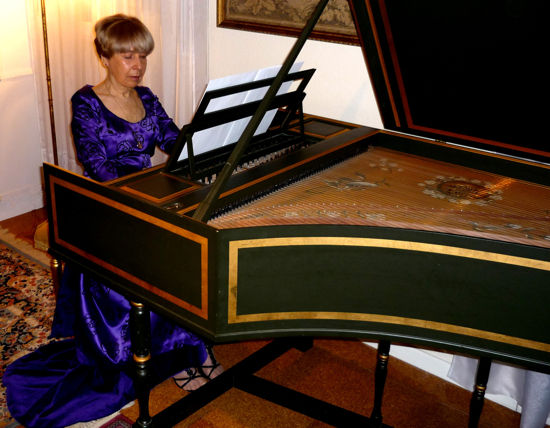
| Albero: Recercata y Sonata prima |
|
Sebastián Albero (1722 Roncal, Navarra - 1756 Madrid) is one of the most important composers of Spanish keyboard music of the 18th century. His musical training began in the Musical Chapel at Pamplona´s Cathedral and his career culminated at the Royal Chapel in Madrid in the service of King Fernando VI. |
| He lived at the Palace along with Scarlatti. While the Scarlatti was serving Queen María Bárbara, Albero was the King’s organist in the Royal Chapel. He left few works but of great quality having died very young. His "Recercatas" are magnificent examples of free and superlative creations of the composer. |
| Although structurally Scarlatti’s influence is evident, the expressive language of his Sonatas, monothematic and bipartite, are different from the Italian. |
 |
| Sebastián Sánchez Cañas: Petenera |
|
“Petenera”, of very flexible rhythm possesses an isometric meter, its modality is always Andalusian and at cadence points it uses the traditional cadence of the same name. The form is a bit free. In this one rhythm and form continue to be effective and I have sought to imitate a) the strophic form (song), b) the “cante” of the interpreter with its turns and melismas, c) the harmonic process based on the chords that accompany this “cante.” (Sebastián Sánchez Cañas) |

|
 |
 |
| Albero: Recercata y Sonata sesta | Vals de Guelbenzu |
 |
 |
| S. Cervetti: Las Indias Olvidadas | Joaquín Asiain: Sonata |
 |
 |
| S. Cervetti: Candombe | Turina: Sonata |
 |
 |
| Pavana y Alix avoit aux dens | Albero: Recercata y Sonata prima |
 |
 |
| Sebastián Sánchez Cañas: Petenera | Soleá y Tango |
 |
 |
| Fandanguito | Boleras Jaleadas |
 |
 |
| La Batalla de Cagancha | Música de clave a cuatro manos(I)- FÉLIX MÁXIMO LÓPEZ. |
 |
|
| Música de clave a cuatro manos(II)-FÉLIX MÁXIMO LÓPEZ. | |
| Boleras Jaleadas |
|
Sevillian composer who arrived in Montevideo in 1829. This composition resembles the” Tonadilla Escénica” and in it the composer mixes in a "totum revolutum" themes of dances, such as the Andalusian Cachucha, the Creole “Media Caña”, a descendant of the Contradanza and the “Tonadilla de Trípili”; clear example of the music that came to Hispanic America. Harpsichord made by Andrea & Anthony Goble in Oxford, after an original by Hieronymus Albrecht Hass, Hamburg, 1740. It has three keyboards. Donated to the Manuel de Falla Archive by Rafael Puyana. |
| The Battle of Cagancha, by the composer Francisco José Debali |
|
The Battle of Cagancha, by the composer Francisco José Debali is a descriptive work in 10 movements. It musically relates the battle (29-12-1829) between the triumphant troops of General Fructuoso Rivera and the invading Rosistas, of Pascual Echagüe. The setting was the Department of San José, Uruguay, in the proximity of the Cagancha creek. Cagancha is an archaic Castilian word that denotes a river or stream and that refers to the Mozarabic phytonimum cacansa species of wild grass. |